Ingestion & Standardization
Unify ego, exo and multi-view video with teleoperation commands, kinematics, joint states, force-torque, telemetry, actions and task metadata in consistent, versioned schemas.
THE MISSING INFRASTRUCTURE
HokFANG transforms fragmented multimodal robotics data — egocentric and exocentric video, synchronized multi-view capture, teleoperation demonstrations, kinematics and joint states, force-torque signals, sensor telemetry and action logs — into structured, traceable and quality-scored datasets for training, evaluation and deployment.
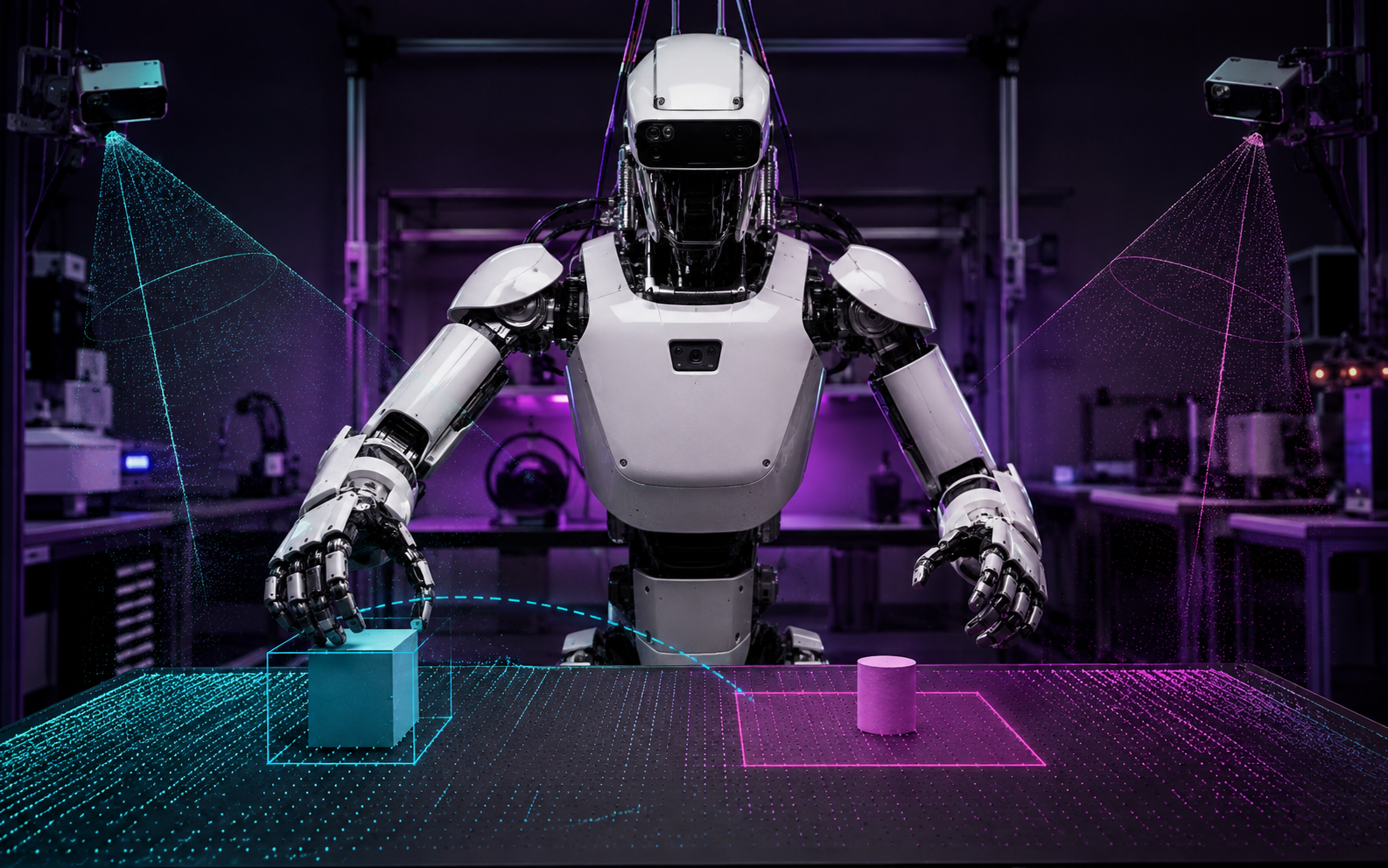
[ 001 // THE MARKET GAP ]
Robotics teams generate RGB and depth video, kinematics, joint states, force-torque signals, telemetry, actions, annotations and task context across real-world environments. Yet much of it remains fragmented, inconsistently structured and difficult to evaluate.
Egocentric and exocentric views show what happened; teleoperation commands and robot-state data explain how it happened. Reliable training requires every modality to be synchronized, traceable, quality-scored and packaged as one coherent episode.
[ 002 // WHAT HOKFANG BUILDS ]
Unify ego, exo and multi-view video with teleoperation commands, kinematics, joint states, force-torque, telemetry, actions and task metadata in consistent, versioned schemas.
Measure multimodal completeness, temporal synchronization, diversity, task coverage, environmental conditions and failure cases.
Evaluate whether datasets are suitable for training, fine-tuning, benchmarking or real-world task validation.
Track data origin, permissions, transformations, versions and delivery requirements throughout the lifecycle.
[ 003 // CORE COMPETENCY ]
HokFANG does not simply deliver data. We connect real tasks, data specifications, usage rights and model validation into a reusable workflow.
Failures · constraints · edge conditions
→What to collect · how much
→Generalize · score · standardize
→Performance comparison · fit evaluation
→Data gaps · next collection
[ 004 // MODEL EVALUATION ]
PROVE THE DATA ON THE MODEL
HokFANG evaluates the delivered dataset on the customer's robotics model. A controlled A/B protocol holds the model, task suite and test conditions constant, isolating the measurable contribution of the data.
95% CI 55.4–61.0
95% CI 85.9–89.9
3 environments · 4 lighting conditions · 2 garment geometries
[ ROBOT TASKS // COMPLETE ACTION SEQUENCES ]
Each sequence shows the complete physical task—not a symbolic animation. The object moves only after contact, manipulation stays mechanically plausible, and the final state is visibly verified.
Detect → approach → close gripper → lift → transfer → release inside the destination.
Localize sleeve keypoints → bimanual grasp → sequential folds → verify the final geometry.
Detect and classify the object → grasp → transfer → release into the correct bin.
[ 005 // CLOSED-LOOP MODEL VALIDATION ]
HokFANG runs the delivered data on the robotics model and tests the model inside the target task. We prove whether the data improves behavior, explain where the model still fails, and turn that evidence into the next collection plan.
Quality-scored, task-specific episodes enter the evaluation.
The same model receives baseline data and HokFANG data.
Fixed tasks and test conditions isolate the effect of the data.
Compare success, generalization, robustness and failure rate.
Failures become precise scenarios for targeted recollection.
CONCLUSION // Improvement is strongest in standard folds. Remaining failures cluster around dark fabrics, partial occlusion and sleeve inversion. NEXT COLLECTION: 2,400 targeted episodes across those three failure conditions.
[ 006 // BUILT FOR ]
Consistent, traceable datasets without distracting the core engineering team.
Well-documented real-world data for reproducible research and benchmarking.
Dataset quality, task coverage, provenance and model suitability before training.
Operational data prepared for applied AI, automation and deployment validation.